
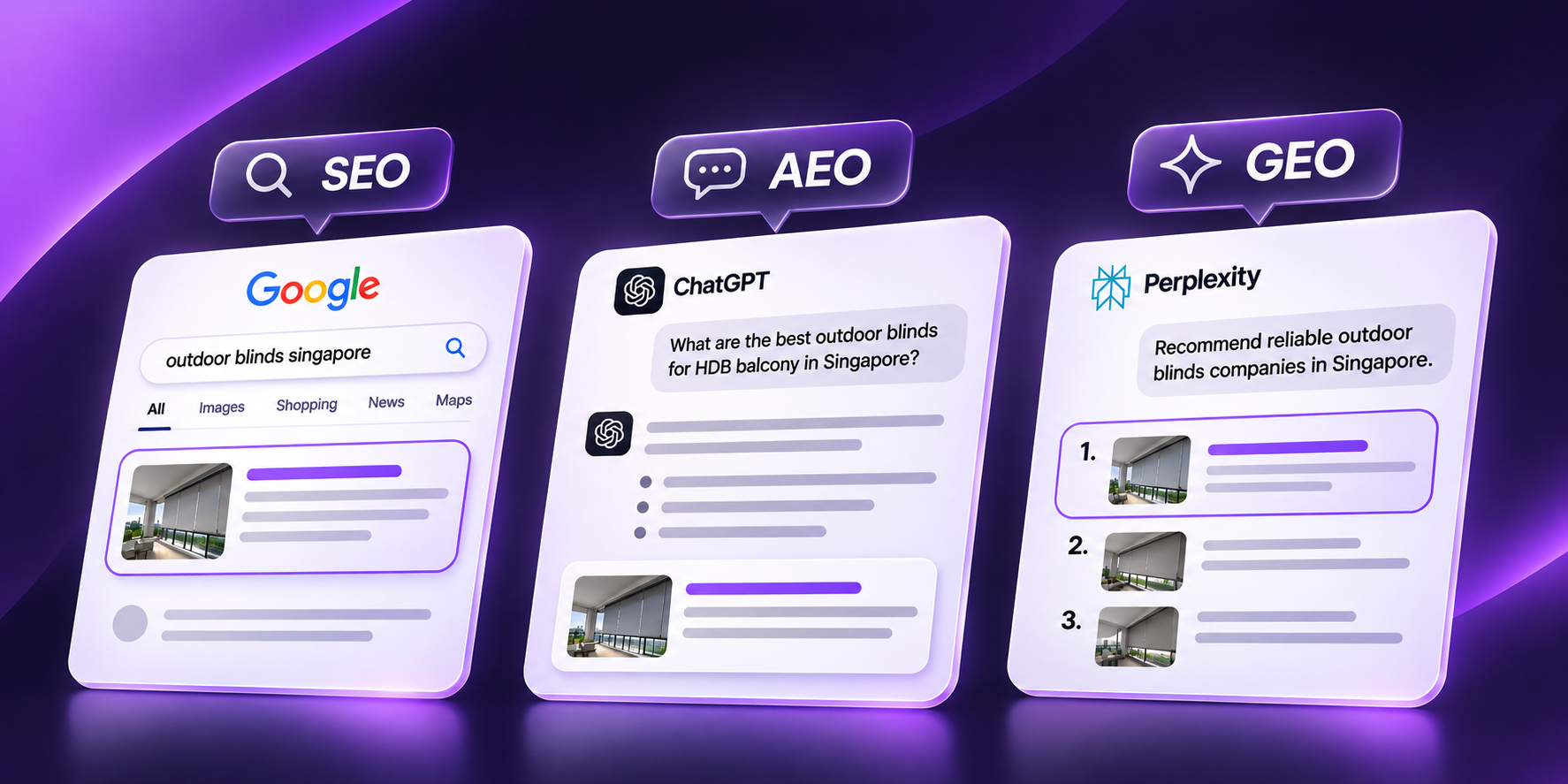
SEO vs GEO vs AEO are three overlapping approaches to how people find and understand businesses online. Search Engine Optimisation (SEO) improves discoverability in organic search results; Answer Engine Optimisation (AEO) makes important questions easier to answer clearly; and Generative Engine Optimisation (GEO) focuses on accurate brand information and trustworthy sources that may inform AI-generated answers. For Singapore businesses exploring GEO services in Singapore, the goal is to combine their strengths around genuine customer needs rather than follow three disconnected tactics.
These are complementary priorities, not independent ranking systems. Useful, accessible content can support all three.
1. What Is the Difference Between SEO, AEO and GEO?
The main difference is what each discipline places first: finding a relevant webpage, answering a question clearly, or making accurate information and evidence available for AI-assisted evaluation. Their practical methods overlap.
| Approach | Main focus and typical work |
|---|---|
| SEO | Organic search visibility: indexable pages, search-intent targeting, technical performance, useful content and contextual internal links. |
| AEO | Question-answer clarity: concise explanations, descriptive headings, accurate FAQs, accessible lists and comparisons. |
| GEO | AI-facing information quality: consistent brand and service facts, evidence-backed content, legitimate third-party references and observed AI-answer accuracy. |
SEO builds a discoverable website that answers actual search demand. AEO improves how directly that content addresses questions. GEO extends the evidence and entity work to situations where people ask AI-powered tools to explain or compare businesses.
None of the three can force a platform to rank, quote, cite or recommend a brand. A table, FAQ or schema markup is useful only when it accurately describes information that is visible and valuable to readers.
2. How Do SEO, AEO and GEO Work Together for Singapore Businesses?
Consider a hypothetical Singapore payroll outsourcing business. A prospective customer might first search for providers, then ask what the service includes, and later compare providers through a search engine or AI assistant. Different content formats support those tasks.
| Customer task | Relevant content and discipline |
|---|---|
| Find a payroll provider | SEO: a specific, searchable payroll-service page with scope, service area and a clear enquiry path. |
| Understand the service | AEO: a direct answer to “What does outsourced payroll include?” with exclusions, process and a useful checklist. |
| Compare shortlisted options | GEO: verified service attributes, transparent decision criteria and credible references that may help systems describe providers accurately. |
This scenario is an example of buyer intent, not a live client case or an observed AI response. One well-maintained resource may support several tasks, but substantially different intents can justify separate canonical pages. Creating three nearly identical pages with different acronyms would add little value.
An integrated approach maintains consistent facts from discovery to enquiry. The broad hire-ready task still belongs to Craft Creative’s main GEO service page.
3. What Practical Work Should Businesses Do for SEO, AEO and GEO?
The most reliable starting point is an accessible website, accurate information and content that directly addresses real buyer questions. Specialist AI-visibility work should build on this foundation rather than substitute for it.
Start with SEO foundations
Identify commercially important services and queries, assign one page to each distinct intent, and check crawlability, indexability, canonical URLs, mobile performance and internal linking. Improve service information and conversion pathways before expanding a blog library.
Make content answer-ready with AEO
Open question-led sections with a clear answer, then add qualifications, examples and useful detail. Give buyers factual service scope, limitations, costs or pricing factors when relevant. Use headings, lists and tables that remain meaningful without a special search display.
Strengthen GEO with brand facts and evidence
Maintain an accurate source of truth for the business name, actual services, service coverage, company profiles and proof. Cite original evidence where available and seek relevant, legitimate third-party references. Record AI responses to real buyer questions; distinguish an unlinked brand mention from an explicit supporting citation.
A practical combined workflow is to map buyer tasks, repair important site issues, publish answer-ready content, verify business claims, pursue authentic corroboration and then measure. Do not invent industry awards, reviews, client outcomes or an “AI trust score”.
For Google specifically, Google Search Central guidance indicates that established SEO practices remain relevant to its AI search experiences; there is no special AI-only markup requirement that guarantees inclusion. Platform documentation and implementation details should be checked again before publication.
4. Which Approach Should Singapore Businesses Prioritise First?
Prioritise the largest verified business problem, not the newest label. Most organisations should fix missing, inaccessible or poorly matched service pages before spending heavily on additional AI-specific content.
| Observed situation | Recommended first priority |
|---|---|
| Key commercial pages are missing or not indexable | SEO: build or repair pages customers can find, understand and contact. |
| Customers ask the same questions before enquiring | AEO: add clear definitions, practical explanations, exclusions and checklists. |
| AI tools repeatedly misstate the brand or service scope | GEO: check canonical business facts, published evidence and the sources cited in observed answers. |
| Search traffic exists, but qualified leads are weak | Conversion and measurement: improve the page offer, CTA, form and attribution before scaling traffic. |
For many Singapore SMEs, SEO foundations and answer clarity are the sensible first investments. GEO monitoring and independent evidence development become more useful when the business has credible facts to communicate and a real reason to be considered in AI-assisted research.
Where two pages answer the same task, improve or merge one canonical resource. Validate ownership against Search Console and Singapore search results.
5. How Should Businesses Measure SEO, AEO and GEO Results?
Measurement should distinguish discoverability, answer usefulness, AI visibility and commercial outcomes. A rise in impressions is not a lead; a brand mention is not a cited source; and a linked citation is not automatically a website visit.
For an initial GEO monitoring baseline, a documented set of 20-30 genuine buyer prompts can be useful. Record the exact question, platform, sample date, Singapore context where available, whether Craft or a competing provider is mentioned, cited URLs and factual accuracy. This is a repeatable observation set, not a universal share-of-voice statistic.
| Measure | What to record and how to interpret it |
|---|---|
| SEO search performance | Relevant query/page impressions, clicks, positions and qualified organic enquiries in Search Console, analytics and CRM. |
| AEO content usefulness | Whether key questions are answered clearly, reader engagement and relevant answer-feature observations where measurable. |
| GEO mentions and citations | Accurate brand mentions and separately observed links within a fixed, dated sample of realistic AI buyer prompts. |
| AI referrals and business value | Identifiable AI-referred sessions and qualified leads, reported with attribution limits and without claiming causality. |
Common questions: GEO does not replace SEO, and schema markup does not guarantee an AI citation. An integrated team can coordinate SEO foundations, answer-ready content, accurate brand facts and evidence without requiring three separate agencies. What matters is the scope of work, source quality and honest measurement.
SEO, AEO and GEO work best as a connected strategy that helps people find accurate information, evaluate a business and take an appropriate next step. Craft Creative brings SEO, content, brand communication and GEO thinking together for Singapore businesses, with a focus on observable performance and qualified enquiries.
Explore Craft Creative’s integrated search services to discuss the priorities relevant to your business.